The World View of Gond Pradhans

Share

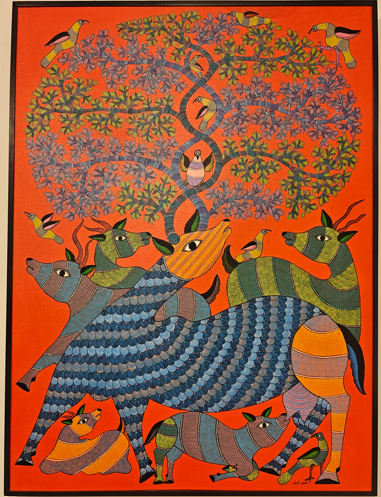
A mixed media work by Phool Chand Dhurve, a Gond Pradhan artist, on view at the exhibition at IIC, through June 26
An ongoing exhibition of indigenous art from Madhya Pradesh brings focus on current trends in this centuries’ old art
The Gond tribal art from the art of Madhya Pradesh is, perhaps, one of the most well-known indigenous art traditions of India, owing in big measure to the ‘discovery’ of Jangarh Singh Shyam by J. Swaminathan in 1981 in the village of Patangarh in Mandla district of the state.
Jangarh belonged to the Gond Pradhan sub-group of the larger Gond tribe. His legacy lives on in the way members of his community continue to create their distinctive art, many of whom have also become established artists in their own right such as Venkat Raman Singh Shyam and Bhajju Shyam, to name only a few.
Delhi gets an exciting opportunity to view the current trends in Gond art, through the exhibition ‘Gond Pradhans of Patangarh: A Dynamic New Art Taking Roots’, presented by the Raza Foundation at the India International Centre, through June 26.
Ashok Vajpeyi, poet, former bureaucrat and trustee, the Raza Foundation, says in his curatorial note: “While the Gond tribal community has had its own artistic modes of expression, the Gond Pradhans, a sub-group, led by the iconic Jangarh Singh Shyam embarked upon a new project of converting the musical memories, songs and narrations into visual images and thereby started a new tradition.”
The exhibition is a relief in the city’s artistic landscape dominated by modern and contemporary Indian art, and a rare occasion to see a good number of contemporary Gond art works in one place.
The exhibition is, indeed worth a visit for anybody interested in all aspects of what constitutes Indian art. It is heartening to note the immense volume of work being produced by indigenous artists, outside the gallery system, which has, in a roundabout way, also ensured that they continue to stay true to their roots and are not yet under the pressure of the market. This is commendable because the works of the late Jangarh Singh Shyam continue to remain collectors’ favourite in the auction circuit.
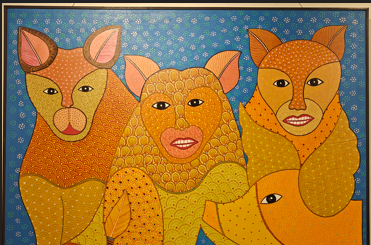
The works on display show a congruent amalgam of ethnic storytelling through the time-perfected vocabulary of the art of Gond Pradhans and it’s ability to incorporate elements of the changing contemporary world around it. For example, the image of three tiger cubs playing with a baby elephant, by Phool Chand Dhurve, is executed in atypical Gond visual lexicon but the theme is decidedly contemporary. The effect is also contemporary as the image looks like the extrapolation of a photo image, with the cubs posing for a camera. A young Gond artist, after all, is as much as creature of the globalised world with a smartphone in hand as of the distinct Gond life in the rather pristine jungles of Madhya Pradesh.
There are numerous such examples that exhibit a confluence of centuries’ old sensibilities welded harmoniously with contemporary aesthetics, which is perhaps, the strongest reason for visiting the exhibition. It brings together works by 21 artists from the Gond Pradhan community.
Despite a plethora of exhibition venues and an innumerable number of exhibitions taking place in Delhi any time of the year, the ones such as the Gond Pradhan show is truly rare. A walkthrough the exhibition hall also helps one get connected one’s roots that we have, perhaps, got disconnected from for too long, for reasons not always in our control.
The exhibition is on view at IIC, Art Gallery, Kamladevi Complex, through June 26, 10 am to 7 pm.