What Exactly is Modern Indian Art?

Share

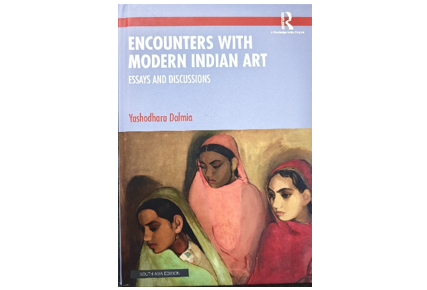
Yashodhara Dalmia’s latest book, ‘Encounters With Modern Indian Art: Essays and Discussions’, published by Routledge
One of India’s foremost art writers, Yashodhara Dalmia distills her long experience of understanding Indian modern art in this book
Living with art in a culturally rich country like India is a reality as real as living and breathing in its air—it’s our very breath. And that’s precisely why we hardly ever go into the minutest details of the composition of our breath. So is the case with art. It is around us everywhere, in different forms, and that’s perhaps why most of us don’t understand its academic classifications; because, it is intrinsic to our lives and we never felt the need to understand it. That is also perhaps why so many of us feel intimidated at the prospect of entering a gallery where an exhibition is going on, even if we truly want to experience it.
In an age of instant information on your smartphone—even if it is difficult to instantly verify if that information is absolutely accurate—a book such as this one, Encounters with Modern Indian Art by Yashodhara Dalmia is a great repository of absolutely accurate information explained succinctly.
Published by Routledge earlier this year, the book focuses on a very vital chapter of Indian art history, i.e., modern Indian art, because that is what is most current, and the regular headlines it makes on big ticket sales gets even non-connoisseurs interested in knowing what it is.
To state briefly, the book answers one of the most important questions in the art world today: ‘What exactly is Modern Indian art?’
There couldn’t have been a better writer than Yashodhara Dalmia to answer this question because there are very few experts in the field who have seen it evolve first hand and regularly written about it after exhaustive interviews with most of the individuals who shaped, and continue to shape, modern Indian art.
The most important popular notion that the book dispels is that modern Indian art began with the arrival of Independence, or a little earlier with the dawn of modern ideas, coinciding with the country’s struggle for Independence. In the introduction, the author writes: ‘The development of modern Indian art could be said to have begun in the last years of Mughal rule. While these were the waning years of Mughal power and wealth, it was at the same time a period of cultural awakening which was to leave its mark for successive decades. Even more the period would become an important marker for the earliest signs of modernity in art for the artists prophetically began to step out of the hallowed sanctuaries of the courts and into the public domain of the man on the street. Furthermore, the style underwent a change with emphasis on lines, form and composition which also drew its influences from Western modes.’
Indian modern art, of whose most famous practitioners are the names that even lay admirers of art recognise, such as M. F. Husain, S. H. Raza and F. N. Souza, to name a few, is a genre of art that evolved over a few hundred years. It did not arrive overnight and many factors played out to give it a distinct identity of its own.
Dalmia traces this long, long journey through lucid chapters, beginning with ‘The Last Mughal Painters and Their Modern Movements’, ‘Colonial Encounters: Shekhawati Frescoes’, ‘Vision of Tagore’, to ‘Aman Nath Sehgal: Partition, Fragmentation and Disjunction’, ‘Excavation/ Eruption: Excavating Realities, Erupting Reflections’, ‘Scroll Painters of India’, and ‘Jivya Soma Mashe: Sense of Self’ to name only a few.
As is evident from the names of a few chapters listed above randomly, the author has taken great care to also include indigenous artistic traditions of India and their tryst with modernity. That’s a very pertinent addition to any book dealing with modernity in Indian art and the author deserves special applause for taking a comprehensive view of modernity as opposed to just a generic view of the impact of modernity on Indian painting as practiced in a handful of its metropolitan centres.
For those who love to dive deep into what makes up modern Indian art, there couldn’t be a better book to have on their study tables. It will definitely help the readers appreciate all genres of modern Indian painting with a more informed light.
Book: Encounters with Modern Indian Art, Essays and Discussions
Author: Yashodhara Dalmia
Publisher: Routledge, 2026
Price: Rs 1295