
Exclusive: ‘Kalo’r Dokan’ at Santiniketan to Get A New Life

Share

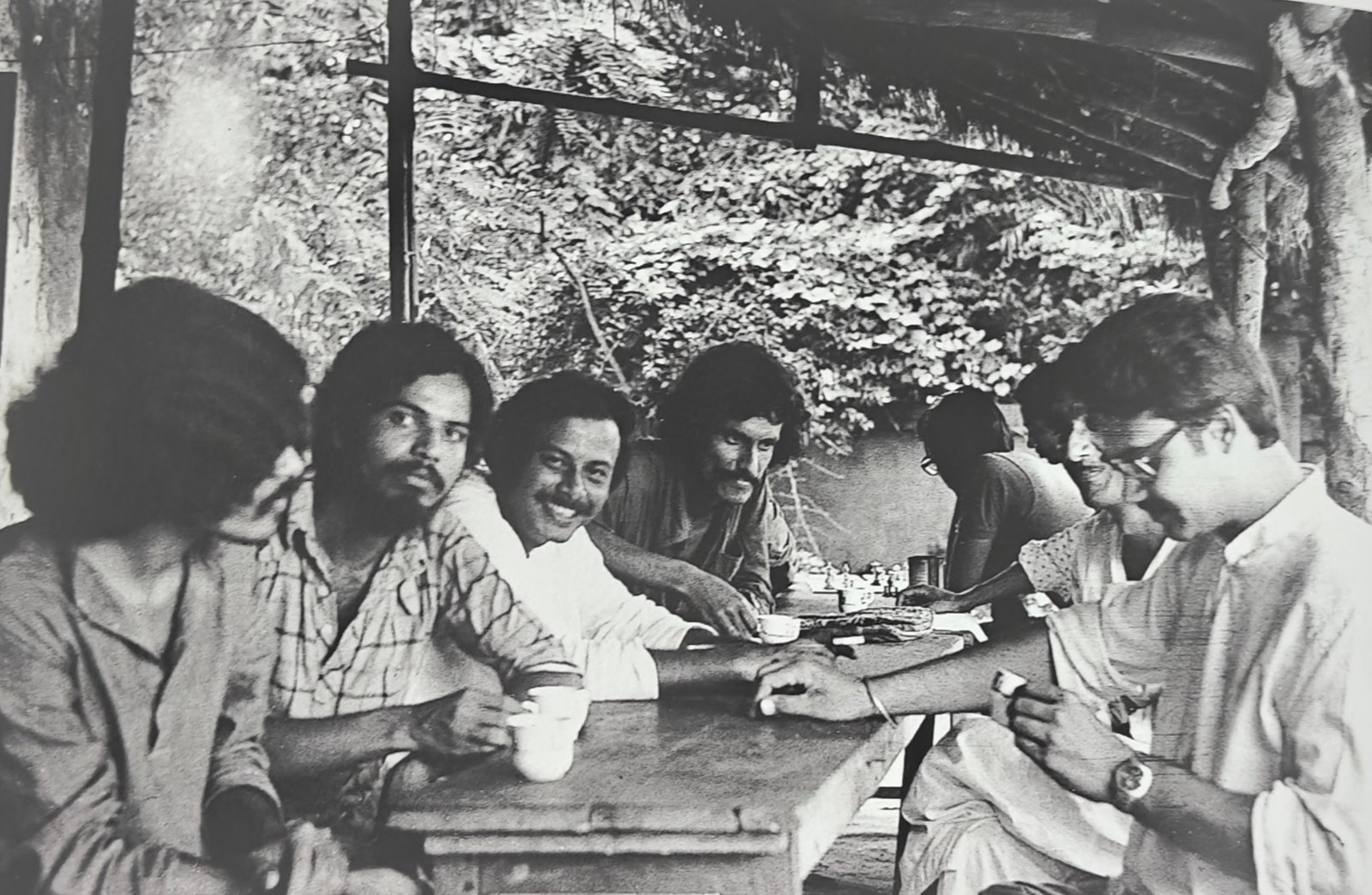
K. S. Radhakrishnan (second from left) at Kalo’r Dokan, Santiniketan, 1978. Image courtesy: K. S. Radhakrishnan
The tea shop existed since the times of Rabindranath Tagore, and will now appear in a revitalized avatar at the 2nd Bengal Biennale
Kalo’r Dokan, or Kalo’s Shop, a nondescript yet historical tea shop at Santiniketan since the times of Rabindranath Tagore, is getting a new life through the efforts of one of the most famous contemporary artists from this revered place, sculptor K. S. Radhakrishnan.
Radhakrishnan, who lives between Santiniketan and New Delhi, is reviving the now derelict tea shop, where he spent countless evenings over tea and adda while studying at the Visva Bharati University for six years, between 1974 and 1980. “This revival project is being readied for the upcoming Bengal Biennale, whose second edition will be held this year,” he informs over an informal chit chat during his brief visit to New Delhi recently. The 2nd Bengal Biennale will be held between November 2026 and January 2027. It will be launched at Santiniketan on November 25, 2026, while it will open in Kolkata on November 28, 2026. It closes at both the locations on January 2, 2027.
The tea shop, known in Bangla as Kalo’r Dokan, was a modest establishment run by a gentleman called Kalo, after whom it acquired its name. “It was a structure made of local materials, bamboo, etc., and served as a great place to connect with fellow students and professors. A very modest establishment, it hosted everybody who had an opinion, where students like me got to speak to great minds from all over the country, while sipping tea at its benches,” recalls Radhakrishnan, who was born in Kottayam in Kerala in 1956 and decided to study arts at Visva Bharati University. He stayed at Santiniketan as a student for six years, studying under some of India’s greatest artists such as Ramkinkar Baij and Sarbari Roy Chowdhury; Somnath Hore, another Indian great, was also a teacher at the same time with whom Radhakrishnan interacted regularly.
Radhakrishnan hopes that his project for the 2nd Bengal Biennale will bring attention to the historic and iconic tea shop, and some means would be devised post the biennale to keep it up and running. “I do hope something works out,” he says.
The tea shop is a repository of innumerable memories, including visits not just by legendary artists but also filmmakers such as Satyajit Ray and Adoor Gopalakrishnan to name a few.